One Year Later: How the Vaynerchuk Recreation Pond Has Come to Life
Sep 24th 2026

Sep 24th 2026
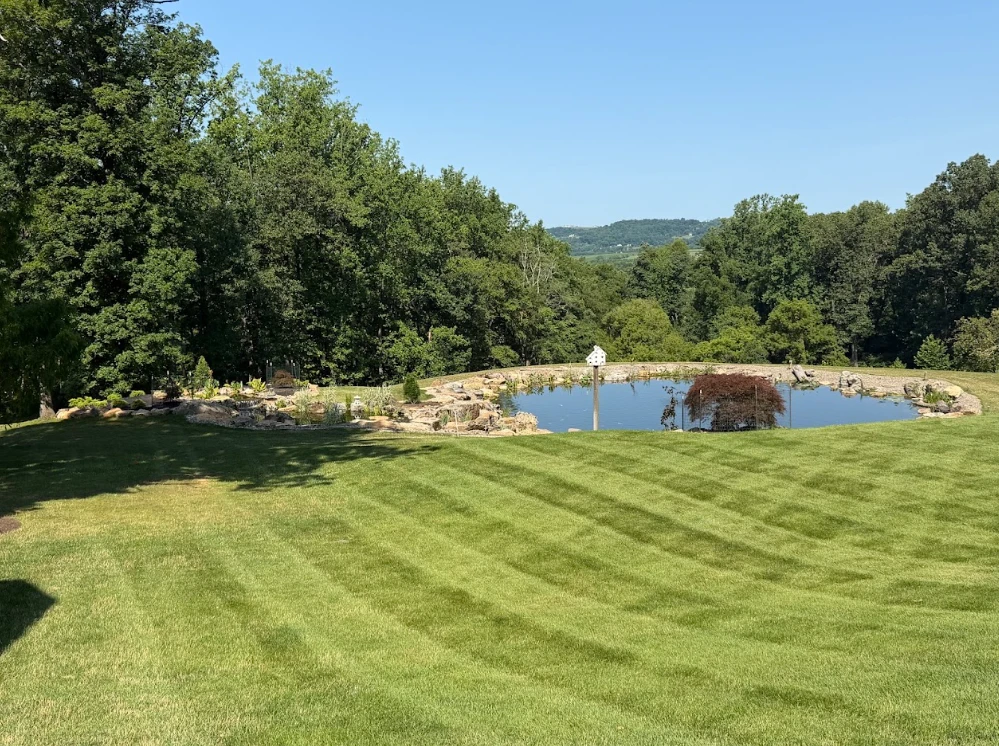
One year after Fitz’s Fish Ponds completed the transformation of Sasha Vaynerchuk’s massive backyard pond, the project has evolved into something even more impressive. What was once a muddy, underperforming body of water is now a thriving recreation pond with clear water, mature aquatic plants, natural stone waterfalls, and Japanese koi, including a new generation of baby koi born right in the pond.
Owner and CEO Brian Fitzsimmons returns to share how the pond has matured, what the team has learned, and why the best ecosystem ponds keep getting better with time.
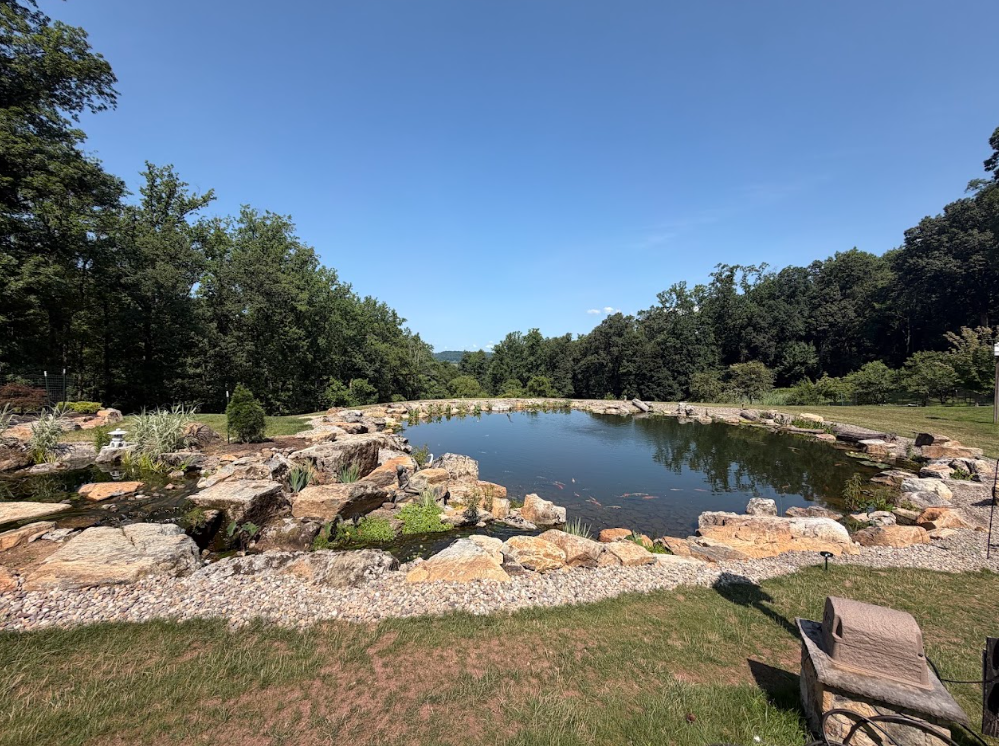
When we finished the transformation of Sasha Vaynerchuk’s pond, I knew we had created something special.
This was never a typical backyard koi pond. It was a massive undertaking involving approximately a quarter-million gallons of water, enormous boulders, waterfalls, wetland filtration, Japanese koi, and an entire landscape designed to feel as though it had always been part of the property.
But one of the things I’ve learned after years of designing and building ponds is that you don’t really know what a pond will become the day you finish construction. That takes time.
A year later, I had the opportunity to return to Sasha’s property and see exactly what had happened. In my opinion, the pond is better now than the day we finished it.
Before we became involved with this project, the existing pond had been a problem on the property for years. The water was muddy and opaque. We joked that it looked like chocolate milk. You couldn't see into it, and despite its size, it wasn't reaching anywhere near its potential.
Our goal was to rethink it completely. We wanted to create a large-scale recreation pond and koi ecosystem that looked natural, kept the water clear, and gave Sasha and his family a reason to interact with this part of their property.
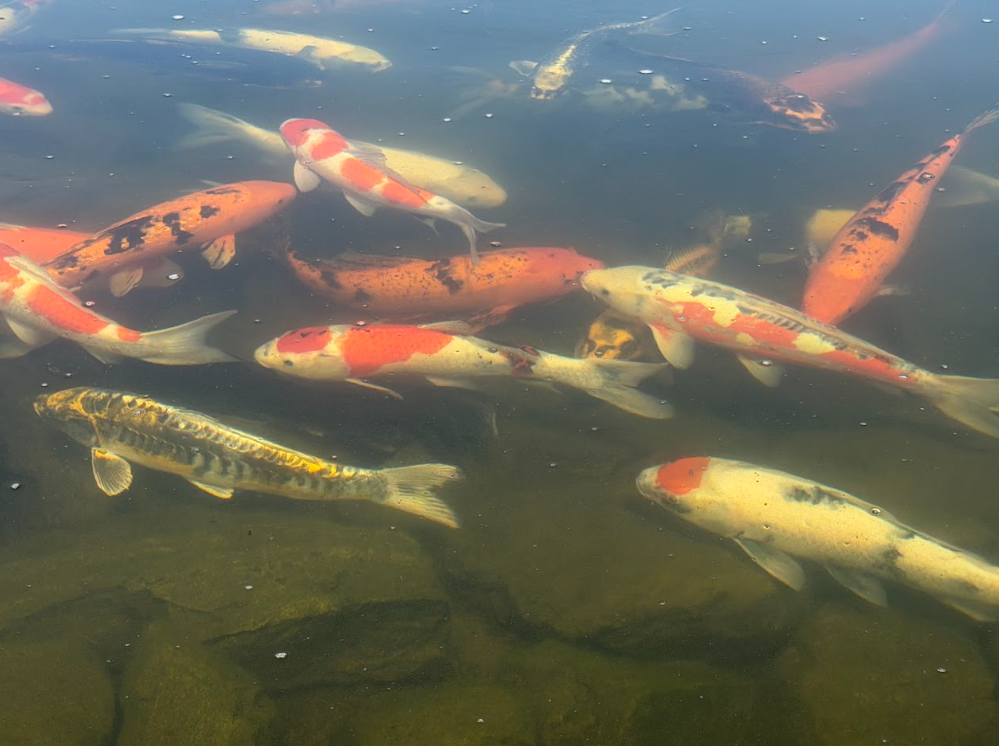
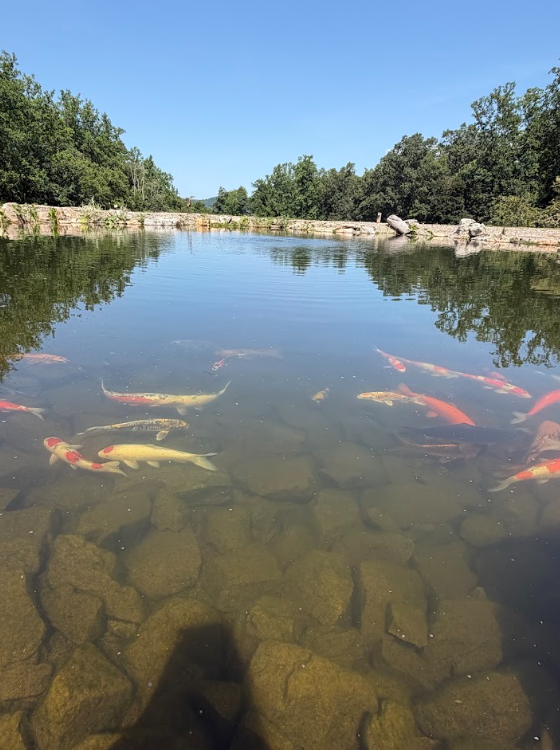
Today, that's exactly what it has become. Under the right conditions, you can see approximately 10 to 15 feet down into the water. Large Japanese koi move through the pond, plants have filled in around the shoreline, and the massive stones that once looked newly placed have begun to disappear into the landscape.
Even better, the koi have successfully spawned. We estimate about 100 baby koi now live throughout the pond. For me, that's one of the coolest parts of returning to a project like this. We didn't simply build something that looks good. We created an environment that's supporting an entirely new generation of fish.
One of my favorite things about natural pond design is that the construction itself is really just the starting point.
When we initially completed Sasha's pond, the boulders, waterfalls, and shoreline established the structure. But nature had to do the rest. Plants needed time to root. Koi needed time to acclimate. Aquatic life needed to establish itself. The surrounding landscape needed to grow around the rockwork.
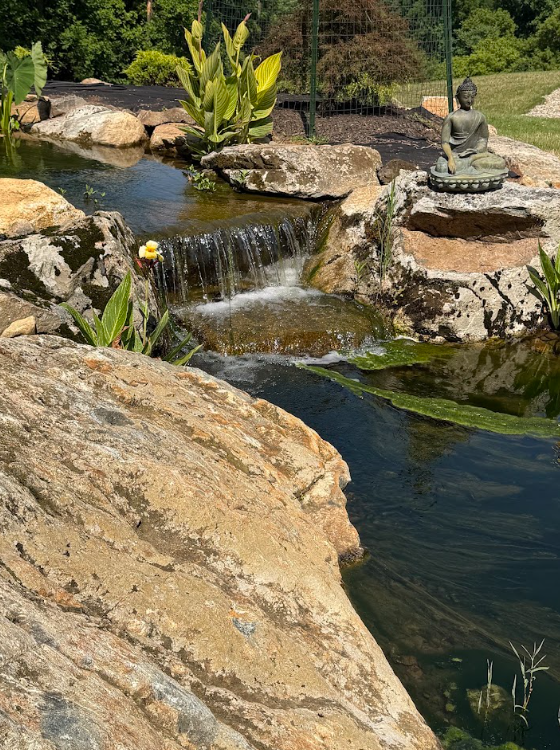
A year later, those changes are obvious. Plants now grow between the boulders and along the water's edge. Water lilies and lotus spread across open areas. Tall marginal plants add height around the shoreline, while lower-growing varieties help eliminate the hard visual line between the pond and the surrounding landscape.
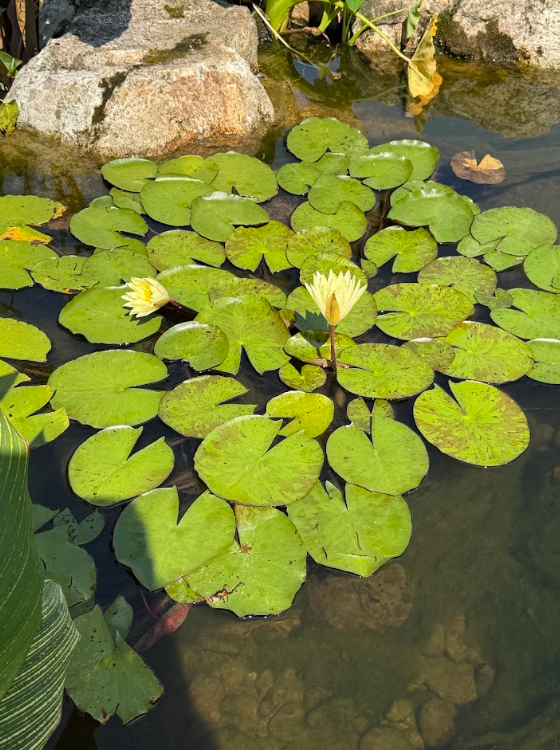
Instead of looking like a pond that was installed on the property, it is beginning to look like a pond that belongs there. That was always the goal.
Plant selection was an important part of the next phase of this project.
Sasha worked with Emily Lane and Tom Swinarsky from our team at the Fitz's Fish Ponds Saddle River location, where they walked through the Hardy Greenhouse and reviewed different aquatic plant options.
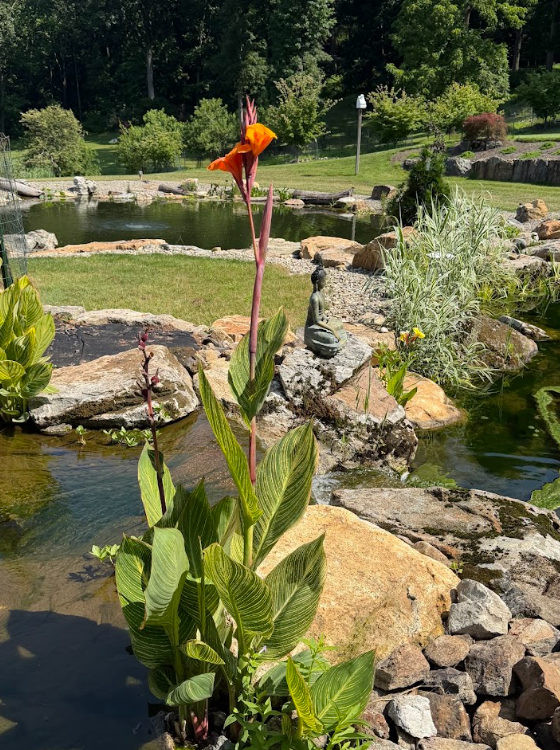
We weren't choosing plants based on flowers and color alone. With an ecosystem pond of this size, you have to think long term. How large will the plant become? Will it survive a New Jersey winter? Where will it spread? How will it interact with the water level? Is it going to be eaten by deer, geese, or even the koi?
The final planting plan incorporated a diverse combination of water lilies, lotus, noninvasive yellow iris, monkeyflower, moneywort, forget-me-nots, hardy water canna, scarlet rose mallow, rushes, four-leaf clover, golden creeping Jenny, reeds, and other aquatic plants.
We incorporated some of the same plants into both the pond and the surrounding landscape. That helps visually connect the water feature to the rest of the property.
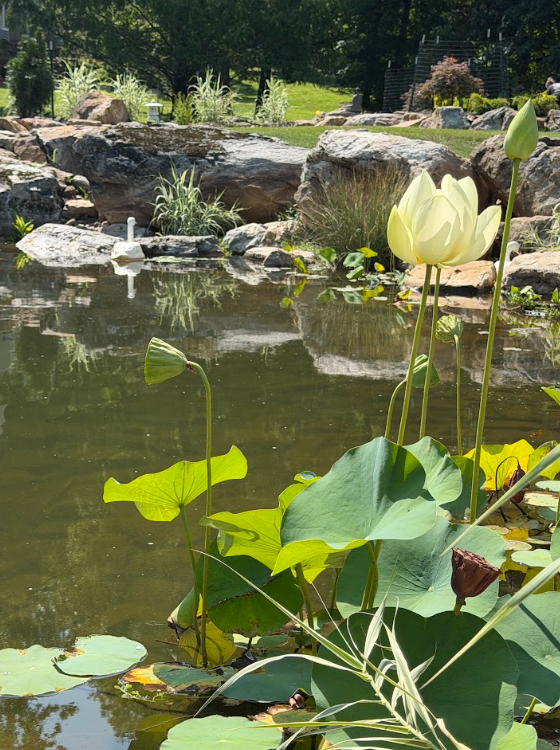
Aquatic plants are obviously beautiful, but we don't add them simply for appearance.
In a properly designed ecosystem pond, plants are part of the system. They can absorb nutrients, stabilize shoreline areas, provide cover for fish and fry, attract pollinators, and contribute to the water's overall biological balance.
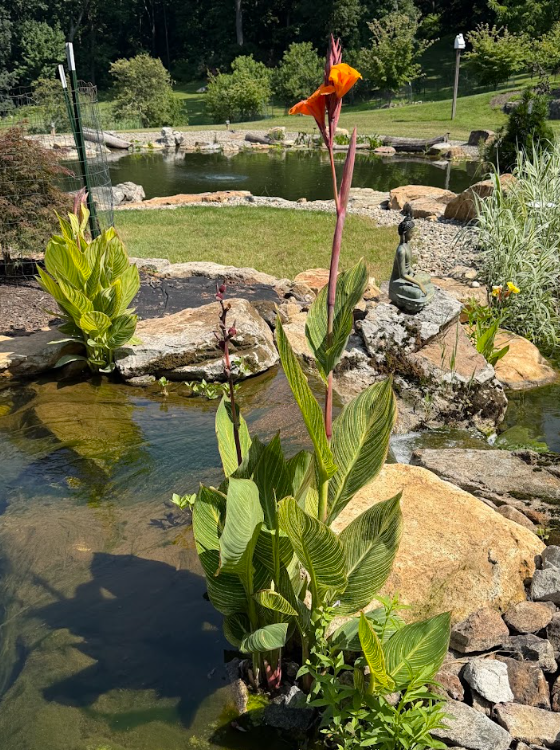
We also incorporated some tropical aquatic plants for additional seasonal color. Those require a different approach here in New Jersey. Before winter, we can remove the tropical varieties and bring them back to our greenhouses, while the hardy aquatic plants remain in place and continue establishing their root systems.
Each season, the hardy landscape should become fuller and more natural.
One of the most unusual challenges with Sasha's pond is that the water level doesn't remain constant.
The pond receives water from rainfall and runoff associated with a nearby stream. Depending on weather conditions, that means the water level can fluctuate significantly.
For a pond builder, that creates a design challenge. A conventional pond edge may look beautiful at one exact water elevation but unfinished when the water drops several feet. We couldn't design this pond that way.
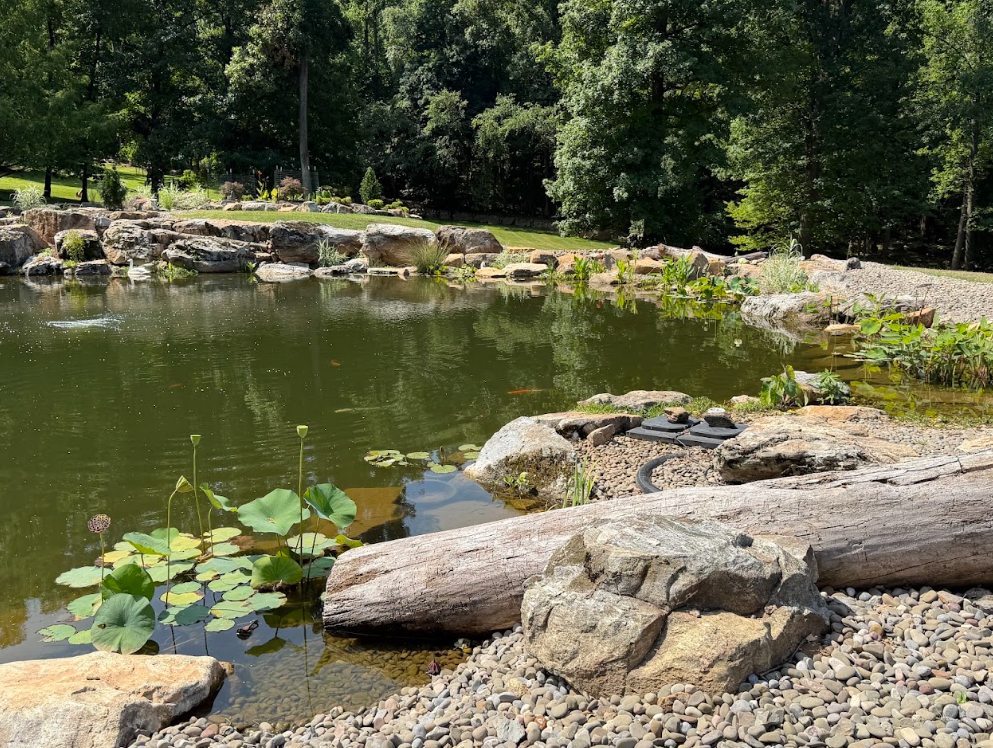
Instead, we created a much broader natural transition using large boulders, smaller stone, gravel, logs, and driftwood. When the water level drops, more of that natural shoreline is revealed. When the pond fills, those elements become submerged. Either way, the edge still looks intentional.
The plants add another layer to that design. Pickerel rush, water lilies, lotus, canna, horsetail rush, and other varieties occupy different elevations and moisture zones, helping the shoreline adapt as conditions change.
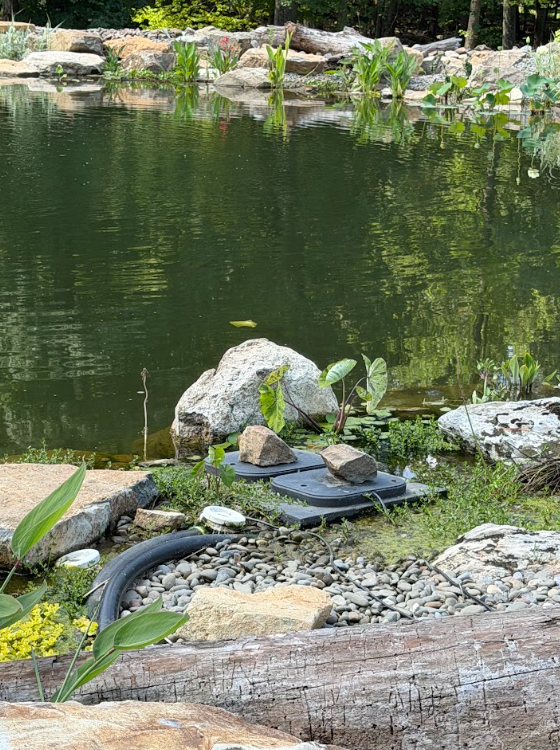
Changing water levels also affected the pond's mechanical systems.
The skimming system, for example, couldn't be installed exactly the way we would approach a conventional koi pond with a predictable waterline. We had to position it lower in the pond and creatively disguise the mechanical components using faux-rock covers and surrounding stone.
Our partners at Atlantic-Oase supplied products used throughout the original build, and Demi, Jeff, and Tyler worked with us to solve some of the unusual engineering challenges the site presented.
The best pond equipment shouldn't be the first thing you notice when you look at a natural pond. Ideally, you shouldn't notice it at all.
Another advantage of revisiting a pond after the homeowner has lived with it is seeing how the space is actually being used.
We're now making some smaller adjustments based on that experience. One example is the lower wetland or bog area. We're adding additional stepping stones so Sasha can comfortably walk through the water and reach the opposite side. The original stones were spaced a little too far apart, so adding a few strategically placed pieces makes the area easier, and more fun, to explore.
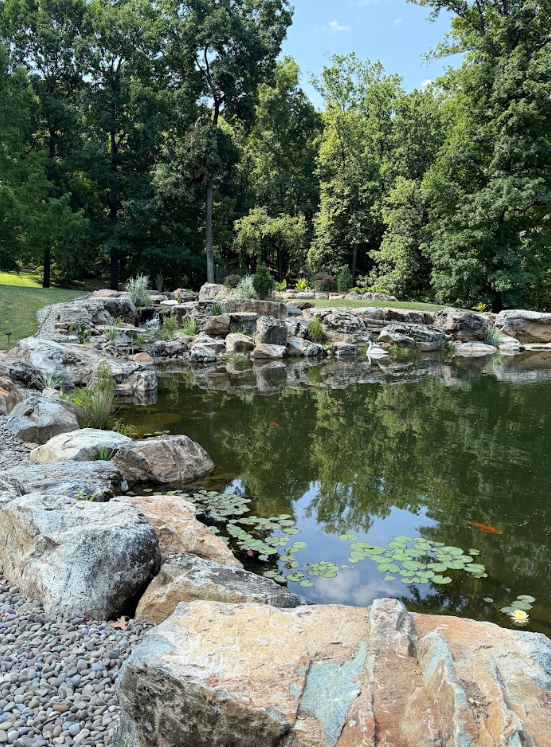
These aren't major changes to the original design. They're refinements. And I think that's an important part of creating custom ponds. A truly great outdoor space can continue evolving with the people who use it.
One of the most interesting places to watch the fish is around the bog and waterfalls.
Small amounts of plant material and natural food sources travel with the water and collect near the base of the falls. The koi have figured this out. They gather there and wait to see what comes down.
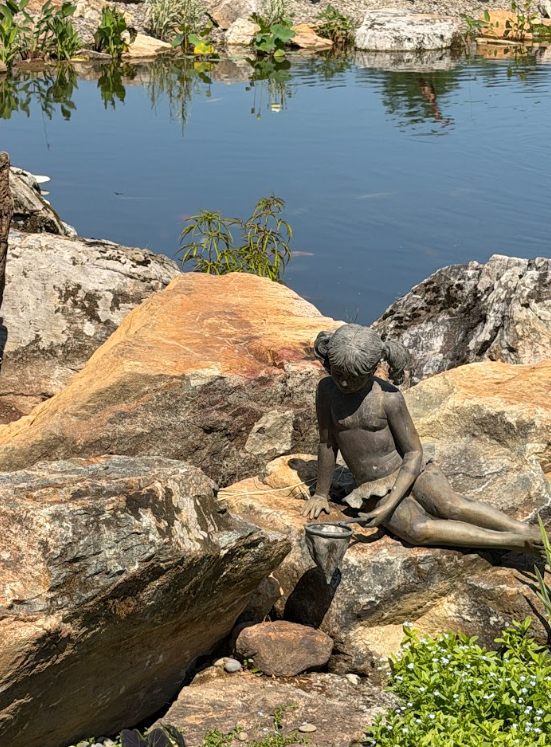
It's a simple behavior, but I love seeing it because it tells you something important: the fish aren't simply living in a pond we built. They're interacting with it as a habitat.
And now they're reproducing in it. The pond's varied shoreline provides spawning areas. Fish caves, rockwork, and planted margins give baby koi places to hide from larger fish. Wetland filtration and aquatic plants improve water quality while also supporting small organisms and natural food sources that young fish can use.
We joke that we've turned Sasha into a koi farmer. Seeing around 100 baby koi swimming throughout a pond that was once an opaque, muddy body of water is a pretty incredible transformation.
The rockwork remains one of my favorite elements of this entire project.
Nearly every major stone we used came directly from Sasha's property. During construction, our team went into the surrounding woods with heavy equipment to extract and transport the boulders. Sasha has lived on the property for decades and knows the woods extremely well, so he could identify the particular stones he wanted us to incorporate.
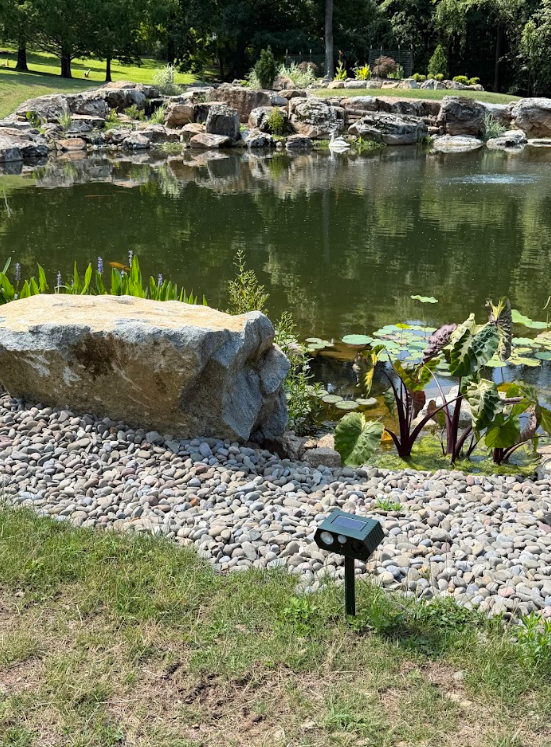
Some of them are enormous, the size of small cars. Those boulders now form the waterfalls, support elevation changes, and establish the shoreline's scale. Smaller stones create ledges, transitions, and hiding places throughout the pond.
We also incorporated logs and driftwood collected from the property. Using those native materials made an enormous difference. Instead of bringing in a completely foreign collection of stone and trying to make it look natural, we rearranged pieces of the existing landscape.
That's one reason the pond feels so connected to its surroundings today.
It's easy to focus on the technical side of a project this large: gallons of water, filtration, pumps, rock placement, water quality, aquatic plants, and fish.
But the most important part of this project isn't any individual component. It's what the pond has done for the property.
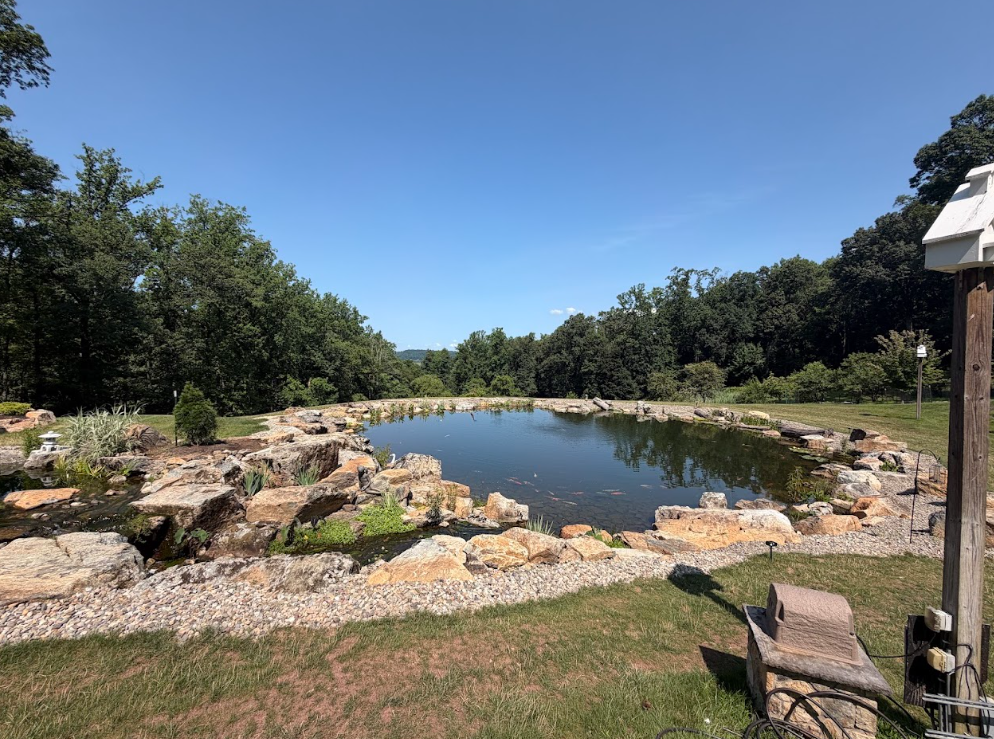
We designed this as a recreation pond, which means the family isn't limited to looking at it from a patio. They can get into the water. They can walk through parts of the feature. They can explore the shoreline, interact with the koi, and experience the pond from completely different perspectives.
Sasha, Gary, and their family now gather around a part of the property that had long been a problem. That's what makes the transformation meaningful to me.
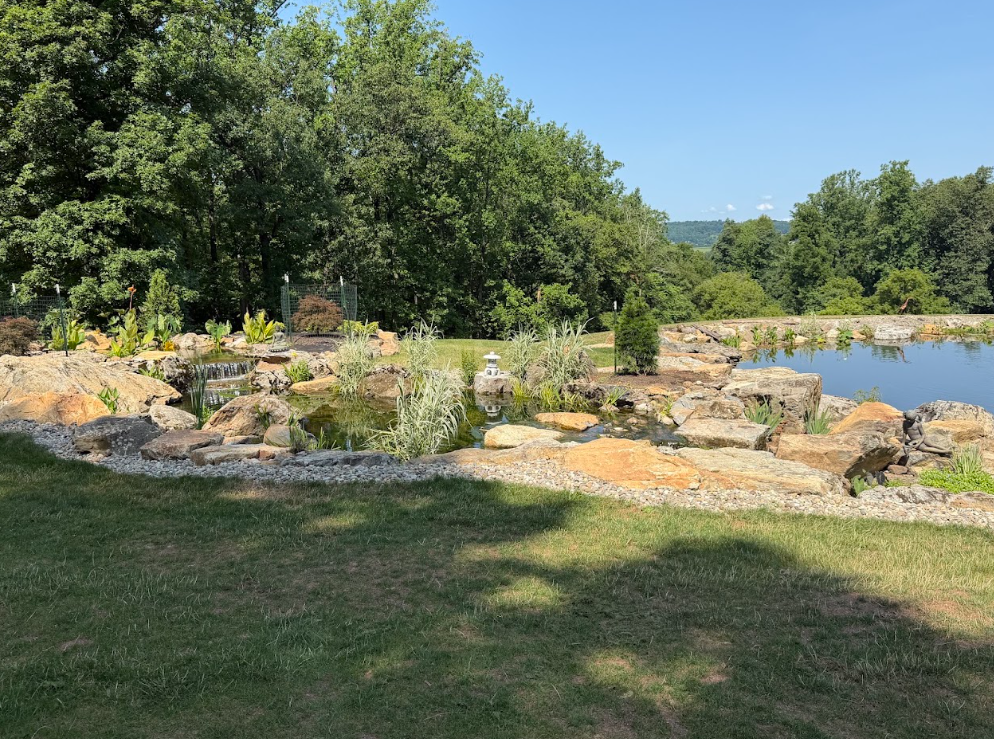
When you first arrive at the property, the waterfall and enormous boulders still make an immediate impression.
But a year later, those aren't necessarily the things I find most interesting. I'm looking at the flowers coming back. I'm watching the koi gather below the waterfall. I'm looking for baby koi hiding between rocks. I'm seeing plants spreading into areas that once looked newly constructed. I'm watching a designed water feature gradually become part of the landscape.
That's what a great ecosystem pond is supposed to do.
At Fitz's Fish Ponds, we don't want to build a pond that looks its best on the day construction is completed. We want to build ponds that become better with time.
One year later, Sasha Vaynerchuk's pond is doing exactly that. And it's still just getting started.
The Vaynerchuk pond shows what can happen when pond construction goes beyond simply digging a hole and adding water. The goal is to create an environment—one that works with the property, supports aquatic life, and gives the people who live there a reason to spend more time outside.
Whether you're considering a koi pond, natural ecosystem pond, recreation pond, waterfall or complete backyard transformation, Fitz’s Fish Ponds can help bring that vision to life.
Ready to start planning your pond? Contact Fitz’s Fish Ponds to schedule a consultation with our team.
What is a recreation pond?
A recreation pond combines the natural appearance and ecosystem benefits of a pond with the ability for people to interact with and, depending on the design, swim or wade in the water. Unlike a traditional swimming pool, recreation ponds can incorporate natural stone, waterfalls, aquatic plants, fish, and biological filtration to create a more natural backyard environment.
Can you keep koi in a recreation pond?
Yes. A properly designed recreation pond can provide an excellent environment for koi. Sasha Vaynerchuk’s pond is home to Japanese koi from Fitz’s Fish Ponds, and the ecosystem has matured to the point that the koi have successfully spawned in the pond.
How do you keep a large pond clear?
Clear water in a large pond depends on designing the entire system correctly. Proper circulation, mechanical and biological filtration, wetland filtration, aquatic plants, appropriate fish populations, and ongoing pond maintenance all play a role. Every property is different, so filtration should be designed around the pond’s size, depth, water source, and intended use.
Do ecosystem ponds get better over time?
They can. A well-designed ecosystem pond often becomes more natural as it matures. Aquatic plants establish larger root systems, beneficial biological processes develop, fish acclimate to their environment, and surrounding landscaping begins to blend with the pond’s stonework and shoreline.
Can Fitz’s Fish Ponds build large recreation ponds?
Yes. Fitz’s Fish Ponds designs and builds custom water features ranging from backyard koi ponds and waterfalls to large-scale recreation ponds and complex ecosystem pond projects. Our team can assist with design, excavation, rockwork, filtration, aquatic plants, Japanese koi, and ongoing pond service.
| Hours | |
|---|---|
| sunday | 10:00 AM - 4:00 PM |
| monday | Closed |
| tuesday | 10:00 AM - 5:00 PM |
| wednesday | 10:00 AM - 5:00 PM |
| thursday | 10:00 AM - 5:00 PM |
| friday | 10:00 AM - 5:00 PM |
| saturday | 10:00 AM - 5:00 PM |
| Hours | |
|---|---|
| sunday | 10:00 AM - 5:00 PM |
| monday | Closed |
| tuesday | 11:00 AM - 6:00 PM |
| wednesday | 11:00 AM - 6:00 PM |
| thursday | 11:00 AM - 6:00 PM |
| friday | 11:00 AM - 6:00 PM |
| saturday | 10:00 AM - 5:00 PM |
| Hours | |
|---|---|
| sunday | 10:00 AM - 4:00 PM |
| monday | Closed |
| tuesday | 10:00 AM - 5:00 PM |
| wednesday | 10:00 AM - 5:00 PM |
| thursday | 10:00 AM - 5:00 PM |
| friday | 10:00 AM - 5:00 PM |
| saturday | 10:00 AM - 5:00 PM |
| Hours | |
|---|---|
| sunday | 10:00 AM - 5:00 PM |
| monday | Closed |
| tuesday | 11:00 AM - 6:00 PM |
| wednesday | 11:00 AM - 6:00 PM |
| thursday | 11:00 AM - 6:00 PM |
| friday | 11:00 AM - 6:00 PM |
| saturday | 10:00 AM - 5:00 PM |
| Hours | |
|---|---|
| sunday | Closed |
| monday | 10:00 AM - 4:00 PM |
| tuesday | 10:00 AM - 4:00 PM |
| wednesday | 10:00 AM - 4:00 PM |
| thursday | 10:00 AM - 4:00 PM |
| friday | 10:00 AM - 4:00 PM |
| saturday | Closed |
| Hours | |
|---|---|
| sunday | 10:00 AM - 4:00 PM |
| monday | Closed |
| tuesday | 10:00 AM - 5:00 PM |
| wednesday | 10:00 AM - 5:00 PM |
| thursday | 10:00 AM - 5:00 PM |
| friday | 10:00 AM - 5:00 PM |
| saturday | 10:00 AM - 5:00 PM |
| Hours | |
|---|---|
| sunday | Closed |
| monday | Closed |
| tuesday | 10:00 AM - 5:00 PM |
| wednesday | 10:00 AM - 5:00 PM |
| thursday | 10:00 AM - 5:00 PM |
| friday | 10:00 AM - 5:00 PM |
| saturday | 10:00 AM - 5:00 PM |
| Hours | |
|---|---|
| Sunday | Closed |
| Monday | Closed |
| Tuesday | 10:00 AM - 5:00 PM |
| Wednesday | 10:00 AM - 5:00 PM |
| Thursday | 10:00 AM - 5:00 PM |
| Friday | 10:00 AM - 5:00 PM |
| Saturday | 10:00 AM - 5:00 PM |
| Hours | |
|---|---|
| Sunday | 10:00 AM - 4:00 PM |
| Monday | Closed |
| Tuesday | 10:00 AM - 5:00 PM |
| Wednesday | 10:00 AM - 5:00 PM |
| Thursday | 10:00 AM - 5:00 PM |
| Friday | 10:00 AM - 5:00 PM |
| Saturday | 10:00 AM - 5:00 PM |